Showing posts with label alcoholism. Show all posts

Monday, April 28, 2014

Book Tour Review: Comfort of Fences


Hello fellow readers! Welcome to my stop on the tour for Comfort of Fences by Stacy Overman Morrison.

Displaying ComfortofFences_.jpg

Title: Comfort of Fences
Author: Stacy Overman Morrison
Publisher: Telemachus Press
Published: October 17, 2013
Pages: 244
Format:  E-book
Source: Received from author in exchange
for an honest review
My Rating: 3 Stars

Synopsis:
Ruth is dying and her 52 year old daughter Denise has never paid a bill, lived on her own, or had a romantic relationship. Ruth knows she has been overprotective, but hoped that she would outlive her special-needs daughter. Metastasized cancer crushes that hope and forces Ruth to find a way to provide for Denise once she is dead. First Ruth turns to Social Security for Disability benefits. After tests, pokes and prods, doctors, nosy psychologists, and ill-furnished waiting rooms, the government declares Denise not eligible for benefits. Mad at the world and daring the government to arrest her so they will have to take care of her since they wouldn't her daughter, Ruth takes up smoking pot in the backyard. A few joints in, Ruth begins to realize her anger is self-directed. She doubts every decision she has ever made in raising her daughter that doctors, in the 1950s, labeled "retarded." Partially to coax her mother from the backyard and partially because Ruth will not speak of the past, Denise asks her mother to write down their history of which Denise has no memory. Trying to atone and explain how she could be so obtuse, Ruth agrees. Telling her story becomes an obsession for Ruth who sees the history as her only chance to leave a place for herself in the world since cancer is steadily eating away her physicality. While Ruth writes, Denise begins to pursue her own independence, despite the minor setbacks of a chopped off fingertip and chemo poisoning. She begins to make choices for herself and finally tells her mother pieces of her own truth: Denise stayed with her mother because she chose to, because she loved her mother more than any life she could make for herself. In claiming her own truth, Denise also chooses silence about the biggest secrets of all. Comfort of Fences explores the messy business of mothering. It is a story about the love between a devoted mother and her special daughter that exposes the irony that the people we love the most can also be the ones we underestimate the greatest.

Melissa's Musings:

Comfort of Fences is slow to start, but once it's up and running, you become involved and interested in the lives of the characters. 

Ruth is the glue of the story and her evolution throughout the book is the most interesting. I felt for her at first, because she seemed so stifled by her upbringing, and at the same time so naive. My opinion of her changed throughout the story as I personally don't agree with some of her choices, especially those involving Denise. 

This book is all about choices. It begins with Ruth's choice to pursue a romantic relationship with a man who turns out to have his own demons, that are ultimately too much for him. It follows Ruth through her life as she chooses to keep and raise a baby eventually on her own, after her parents try to interfere in a way that she doesn't like. 

The book deals with subjects that may be sensitive for some readers. It deals with alcoholism, mental disability, and cancer, to name a few. It is also what I would call heavy with religious elements. If any of those themes make you uncomfortable, I wouldn't recommend this book.

The format of the book is one that worked well for the story. When Ruth learns that she is dying of cancer, she decides to write down her story for her daughter, rather than try to explain it all to her. I think this was a nice touch, as it gives Denise a physical keepsake of her and her mother's lives together. Plus it ties the story together well.

As Ruth writes out the story, it the novel weaves in and out of the past and the present. As Ruth's battle with cancer becomes more serious, you get the sense of urgency in the telling of the story for Denise.

Of all the character's Georgia is my favorite. She's full of spontaneity and energy. But she also has a sadness to her that is so human. As happy and independent and carefree as she seems, she's just as weighed down by life as anyone else.

I felt that Denise's character was the most flat. She felt stifled, suffocated even. Both literally and figuratively. And maybe that was the point, as part of Ruth's evolution at the end of the novel is that she only hopes that Denise can see why she made the choices she made, and why she felt she had to stifle Denise. It was to protect her from all of the negativity in the world. I do understand where the development came from in terms of the story itself, but in terms of reality or real world application, I felt that the expectations for Denise were stereotypical, and that felt slightly demeaning in a way.

This book isn't without its flaws, but the overall story of friendship, and the demonstration that all the choices we make have an impact on the outcome of our lives are poignant themes that will stick with you after you finish this book.

Thursday, October 10, 2013

Book Review: The Rockin' Chair

The Rockin' ChairTitle: The Rockin' Chair
Author: Steven Manchester
Publisher: The Story Plant
Published: June 25, 2013
Format: Kindle
Pages: 272
Source: Received from the publisher
in exchange for an honest review
Read: September 23, 2013
Genre: Contemporary
In A Few Words: Poignant
My Rating: 5 Stars

Goodreads Synopsis:
Memories are the ultimate contradiction. They can warm us on our coldest days or they can freeze a loved one out of our lives forever. The McCarthy family has a trove of warm memories. Of innocent first kisses. Of sumptuous family meals. Of wondrous lessons learned at the foot of a rocking chair. But they also have had their share of icy ones. Of words that can never be unsaid. Of choices that can never be unmade. Of actions that can never be undone.

Following the death of his beloved wife, John McCarthy Grandpa John calls his family back home. It is time for them to face the memories they have made, both warm and cold. Only then can they move beyond them and into the future.

A rich portrait of a family at a crossroad, THE ROCKIN' CHAIR is Steven Manchester’s most heartfelt and emotionally engaging novel to date. If family matters to you, it is a story you must read

Melissa's Musings:

This is the 2nd book I've read by Steven Manchester. His first, Twelve Months, pulled me in from the very first page. The Rockin' Chair is no different. I don't know quite how he does it, but Manchester manages to create a world that the reader is immediately pulled into from the very first sentence. I settled in instantly, already feeling at home with the family from the start.

This book deals with some tough issues.

 At the forefront, we have John, the family patriarch. He's a beloved grandfather, a father, a hard worker, a devoted husband. We watch as he struggles with watching his wife Alice lose her memories to Alzheimers.

The relatioship between Alice and John is beautiful. The kind that most of us dream to have. Where someone loves us so much that they will take care of us through anything, no matter how difficult life gets.

 Upon Alice's death he calls his family back to his farm in Montana.  We watch as he pieces the family back together again, using memories. Some lighthearted and positive, some not so happy. He helps his grandchildren deal with some of their inner demons.

 Evan ran away from the farm, eager to get away from his abusive father and small town life. He was hoping to settle down with a girl who he thought he loved, who only turned around to break his heart by cheating on him. George, a war veteran whose time at war caused him to make some decisions that he wasn't proud of, is still fighting, even though he's returned home. Only now he's fighting to come to peace with himself. And Tara, who left for New York hoping to make it big, only to fall to the temptation of drugs and alcohol, who knows she needs to change her ways for her young daughter.

It's an emotional journey as you read on to discover how John manages to help each one of his family members. Painful as it is to relive some of these memories that John helps each family member recall, there are lessons in each of them. He even manages to bring some peace and redemption to himself, and repair his relationship with his son Hank.

The rocking chair that the story's title comes from is a central part of the story. It has an intimate significance to the bond that the family shares. The idea of a rocking chair holds different memories and ideals for each of the characters throughout the story. One thing I've noticed is that each of Manchester's recent books features a chair/chairs on the cover. 

 This book had me in tears several times over the course of reading it. I devoured it in a few hours. Even though the story was resolved well, it still left me wanting more. I can't wait more from this talented author.

Monday, January 7, 2013

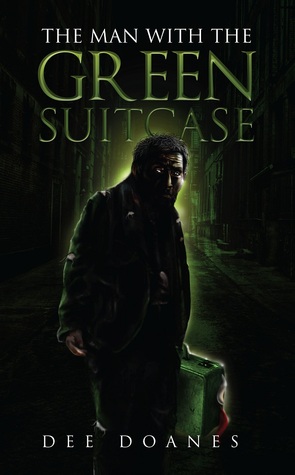
Review: The Man With the Green Suitcase

The Man With the Green SuitcaseTitle: The Man With the Green Suitcase
Author: Dee Doanes
Publisher: Wld Enterprises
Published: July 30, 2012
Format: Kindle
Genre: Fantasy
Pages: 328 pages
Source: Received from the author
in exchange for an honest review
Read: December 31, 2012-January 2, 2013 
In  A Few Words: Unusual 
My Rating: 2 Stars

Goodreads Synopsis: What does... 
A prostitute, 
A corrupt businessman,and 
A disfigured young woman 

Have in common with a mysterious, old homeless man who carries a green suitcase? 

The old man comes into people’s lives because it is important for them to experience the visions that he is somehow able to show them—visions that even he doesn’t understand. But whoever he connects with will go through a transformation that will change the course of their life, for better or worse. The old man has no memory of who he is or even what the suitcase holds. But one day he will find out all about his own secret and dark past… 

This story is magical realism, realistic with paranormal elements, a mystery that needs to be solved, and a man and woman who will finally realize that they were meant to come into each other’s lives and remain forever

Melissa's Musings:

The overall concept of this book is really interesting. There's a homeless man who wanders the streets, stopping by a local shelter to get food and a shower, once a week. While there he's connected with several different people, some good, some bad, and he shares visions with them. This man doesn't remember who he is or his past and is pretty much a loner, all he knows is that he must pass on the visions to the people they are intended for.

 The interesting thing about this is the way the visions come about. When he is with someone and needs to pass along one of these visions, the energy builds up inside him, and the wrinkles on his face start to change. The energy buildup shines through the man as light. 

Of course this special ability makes people want to be around him even more, but he tends to shut people out and do his own thing. There are lots of other characters, but I don't want to talk much about them because I'll give away major plot points if I do. The main focus is on the man with the green suitcase and it's his visions that tie all of the characters in the book together. All of his visions do come true, in one form or another.

As interesting as this part of the plot is, I feel that the writing could have been a lot more polished to help pull the reader into the story more. The writing is somewhat stilted in places. It also feels like the descriptions are somewhat cluttered. I find it odd to be saying that there are too many details given, but that's what this felt like. It just feels like the author is trying too hard to set up the scene for the reader, and that leads the cluttered descriptions and halts the flow. Instead of flowing naturally, these overly descriptive passages feel clunky.

There are a few other weak spots in the structure that pull you away from the reading as well. The book switches tenses often, even in the middle of paragraphs. There are also a lot of instances of repetitive phrasing throughout the story, sometimes one right after the other. There's a section where the story alternates between Valerie and Gerald and they mirror phrases almost exactly, one right after the other. Sometimes this can work, but it didn't quite work here. The alternations with headings, in the middle of chapters was also unsettling. I think that if the story had simply been told from their perspective for the whole chapter it would have been better than alternating between them in the same chapter. 

Also, in a lot of sections there are sequences that I think are meant to be told as flashbacks which are all italicized. A few of these interspersed throughout the story would have been okay, but there are several and they are quite distracting.

One element of the book that I really enjoyed was the aspect of volunteerism. The author did a good job of really making it so that you can understand how life as a homeless person can be. It was nice to see characters who really enjoyed volunteering and helping others. There is also a character with mental illness in the story and while there was some description of that, it would have been nice to see that issue touched on a bit more thoroughly, in order to be able to better relate to Valerie's character.

The ending itself made no sense to me. The book was so focused on the man with the green suitcase and his power, that the buildup to his back story and his whole reason for being the way he was felt rushed, and it wasn't revealed until the very end, so I didn't have as strong feelings for him as I might have had I learned more about him sooner. The ending fell flat for me, due to lack of character development. 

The story is described as magical realism, and I feel that it was too focused on the magical part to really connect to it.

Tuesday, December 11, 2012

Heaven Or Hell by Roni Teson

Heaven or HellTitle: Heaven Or Hell
Author: Roni Teson
Publisher: Balboa Press
Published: July 31, 2012
Format: Paperback
Pages: 319
Source: Received from the
author in exchange for an honest review
Read: December 1-3, 2012
In A Few Words: Ethereal, limbo-like
My Rating: 3 Stars

Goodreads Synopsis:

Following years of living in an alcoholic fog, Joe becomes an upstanding member of society-but only after he experiences a trip through Hell itself. Teresa creates her own Hell in current day Los Angeles where she struggles with her past while trying to raise her teenage son. Am I in Heaven or Hell, Angel wonders, as she floats restlessly from cloud to cloud, finding herself in constant pursuit of an earthly Teresa and not knowing why. Heaven or Hell is a story of tragedy, loss, and a triumphant life-changing resurrection when the lives of Joe, Teresa, and Angel collide in this world and beyond

Melissa's Musings:

To be honest, I'm not quite sure what to make of this book. It's an interesting story, but I don't think that I went into this quite expecting to read about this particular story.

The story focuses on a family that's been broken apart by alcohol abuse and death. Teresa and her sister Angela were in a car accident that killed Angela and injured Teresa. Joe, who was already in the throes of alcoholism due to his wife's cancer, became even more distant, and eventually ended up homeless. Marion, the girls' mother, died shortly after Angela did. So, Teresa was left all alone, save for her Aunt Jessie.

Teresa does relatively well for herself, opening up her own business. But her marriage fails and she is left to raise her son alone.

Teresa is a character who I felt had major control issues. Her quirk is cleaning, for one. She often cleans when she's stressed or upset. There's nothing wrong with that but she seems to take it to a level of obsession, re-cleaning her store after asking one of her employees to do it, and then cleaning smudges off her car handle when she gets in and out. It was just a really odd quirk. And the control seeps over into other areas of her life, and when it does, anger pops up at really unexpected times. There are a few instances in the book where Teresa wants to slap her son JJ for things he says or does, but these aren't really bad things, like trying to joke around with his grandpa. The anger and wanting to slap him felt really sudden and just out of place for her character.

Contrasted with Teresa's anger, there's Joe's seemingly infinite patience in trying to resolve  his situation and make things better with his girls. Joe is portrayed as the ultimate saint who has helped many people suffering on the streets with alcohol and drug problems like he once did. I was disappointed in the fact that Joe's incidences of helping were so overplayed in the book. It felt like he was let off the hook for abandoning his family since he did all of these other great deeds, and I just don't think that's right. In this sense I can truly see where Teresa's anger is warranted because I felt the same thing as a reader. I think he got off too easily. Yes, he did apologize and he did try to make things right, but it just felt like too little too late.

The one thing that I think could have been improved about Joe's character was the name. As far as I can understand, though I may have misinterpreted, the character's given name is Juan. At some point through his experiences, he starts to go by Joe, but some people continuously refer to him as Juan. All throughout the book people kept saying things like "Joe, or Juan or whatever you call yourself now..." I think it would have made things a lot easier if there had been some sort of definitive statement like "I used to go by Juan, but now I go by Joe since I've changed my ways" and then just had everyone call him Joe after that. The other characters not knowing how to address him made these scenes flounder a bit.

The story definitely has elements that will make you think . There are scenes where Joe is going through his own personal hell complete with being stuck in a pit and floundered after by zombie like creatures that are grasping at him through the muck. You're left to wonder, was any of that real, or was it just some sort of detoxing hallucination? There's also the contrast to this hell, with Angela's character being stuck in limbo in the clouds after she refuses to leave Teresa when she dies. Angela's character is sweet, but also very mature after having been stuck in limbo after so long.

The story definitely prompts thought on what really happens when people pass away. The author gives the impression that the next chapter after life on earth, whatever that may entail, is closer to us then we all might think, rather than being miles and miles away.

There are religious elements to the book but they are kept simple and don't  go into any great detail, which I truly appreciated.